
Making Friends with Fear
What if fear isn’t something we need to overcome, but something we can learn to work alongside? In this piece I explore our relationship with fear through the lens of rock climbing, considering how fear can provide important information while also influencing the choices we make. By noticing what fear is telling us, rather than allowing it to take over, we can begin to respond with greater calm, intention and self-awareness. I consider how coaching can help us understand our fears, challenge the assumptions behind them and take meaningful steps forward.
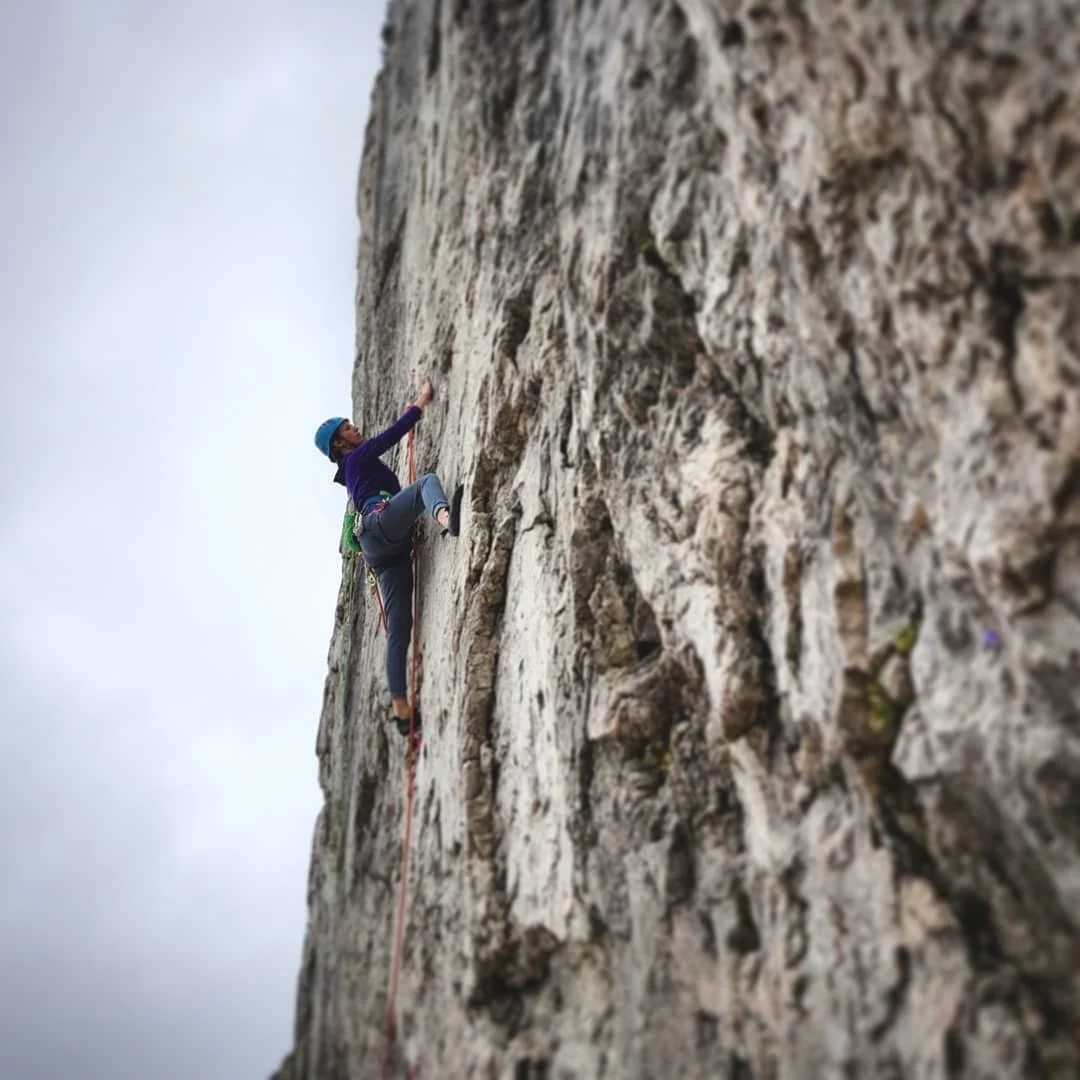
Climbing on the Hexenstein (aka Sass de Stria) at the Falzarego Pass in the Italian Dolomites.
Climbing with Fear
I love rock climbing for lots of reasons. One of those is the intimacy it gives me with fear. Over the past few years, I’ve spent a lot of time learning how to exist alongside fear when climbing. Noticing how and when fear shows up, understanding how it affects me, and practicing how not to let it take charge has made a huge difference. Trying to respond intentionally to fear makes my overall climbing experiences more enjoyable, and has helped me tackle routes I would once have backed away from (even if I can’t always get up them.)
I find it’s a practice that maps beautifully onto life too.
When I get scared climbing, I have one of two impulses. One is to back away altogether. Not try the bold move, sometimes not even start the climb at all, just in case I can’t do it. The other is to do the exact opposite: climb up away from the fear as fast as I can. Sidestepping my fear of falling by rapidly and recklessly increase the size of the possible fall. This is, plainly, an idiotic impulse.
When fear is in control I become a worse climber. My footwork becomes flustered. I over grip. I miss holds that are right in front of me. My thinking narrows and, crucially, I stop trusting myself. All of which increases the chance of the thing I was trying to avoid in the first place. It’s hardly a masterclass in logic. But that’s the thing about fear: it rarely helps us make good decisions.
So what to do when fear shows up?
If you’ve done any trad climbing you’ll know the smart response isn’t to power through recklessly. It’s to pause. Sometimes to retreat to a stance that feels stable. Check your gear, regroup, breathe, plan your next moves. Know where your next piece of gear is going in.
And then calmly and intentionally commit to the next section.
For me, the goal isn’t to eliminate fear. The real satisfaction for me lies in learning to climb alongside fear. To let it be there without letting it take over. To make friends with it and notice if it’s whispering maybe just don’t try, or shouting to just get it over with, but to not allow either of those voices to take over my body.
Coaching often meets people in the same space.
Sometimes fear shows up before we’ve had a chance to try: What if I try and fail? What if I’m not good enough? What if I don’t have what it takes? So we don’t even start, or we keep our goals small, or we over-prepare endlessly just in case. Other times, we’re already halfway along a path when fear kicks in. Not the kind that stops you in your tracks, but the kind that makes you scrabble. The kind that makes you rush decisions, grip too tightly, move without thinking. And, in life, that scrabble can look like making choices that aren’t really yours. Not because they’re what you want, but because they feel like an immediate way out of uncertainty, a way to prevent a fall.
Fear doesn’t just make us hesitate. It can speed us up in the wrong direction.
We end up out of alignment with ourselves and our values because, in trying to stay one step ahead of uncertainty, we’ll often grasp for the things that feel familiar and fit a template we’ve seen played out by others. One of the things I find so compelling about coaching is how effectively it can help us notice when fear is taking over. How it enables us to ask: Is this fear protecting me or limiting me? Coaching can help us learn to pause. To check our metaphorical gear, to breathe, to remember our reasons for being somewhere bold and scary in the first place. It can help us look at the story fear is telling us and challenge the assumptions that come along with that. Not to become fearless, but to become free from fear-based decision making. Because when we stop letting fear set our direction of travel, we make room for something else: clarity, confidence, choice.
Managing my fear when rock climbing is definitely still a work in progress, but I love how the work I put in on the rock impacts the way I make choices in life. It’s also one of the reasons I love coaching: supporting other people as they pause, breathe, check their gear, and choose their next moves with intention.
And because sometimes, in life as with climbing, allowing space for that little frisson of fear can ultimately facilitate a sense of flow.